
Location: Bozeman, MT
Fleet type: Light-duty electric vehicle
Narrative

Niko Little is an HVAC installer based in Bozeman, Montana, whose work primarily spans the greater Gallatin Valley. His day-to-day projects focus heavily on residential and small commercial heating and cooling systems, with a growing emphasis on high-efficiency electrification technologies such as cold-climate heat pumps. Over the past several years, his work has increasingly aligned with a broader regional shift toward electrified building systems and reduced reliance on fossil fuel heating.
As part of both his personal and professional routine, Niko has used a standard-range Ford Lightning electric pickup truck for approximately three years. The vehicle serves a dual purpose: transporting tools, materials, and equipment to job sites across the valley during the work week, and functioning as a personal vehicle outside of work hours. Its combination of utility capacity and electric drivetrain efficiency has made it a practical fit for an installer frequently moving between dispersed residential job locations.
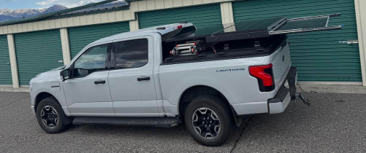 A key development in Niko’s transition toward greater energy independence has been the installation of a small rooftop solar array on his truck, consisting of four panels. This system provides supplemental energy that can be used to charge the truck during weekends or while parked at home during the day. While modest in scale, the installation reflects a deliberate effort to align personal transportation with on-site renewable energy generation and reduce dependence on grid electricity when possible.
 Niko’s interest in electric vehicles is closely tied to his professional focus on efficient heating and cooling systems. As someone who regularly installs heat pumps and educates clients on energy-efficient HVAC solutions, he views his EV not as a separate technology, but as a natural extension of the same principles: reducing energy waste, improving system efficiency, and transitioning toward electrified infrastructure.
Operating in the Gallatin Valley presents a range of seasonal and geographic challenges, including cold winters and variable terrain. Despite this, the electric truck has proven to be a reliable work vehicle, capable of supporting daily travel demands while offering reduced fuel and maintenance costs compared to traditional internal combustion alternatives. The ability to charge at home further simplifies logistics and reduces downtime between jobs.
Outputs & Outcomes
 The use of a light-duty electric pickup in a professional HVAC context demonstrates the practical viability of EVs for trade-based work in semi-rural environments. Niko’s experience highlights how EVs can support daily commercial activity without compromising functionality, even in regions with cold winter conditions and variable job site distances.
The integration of a small solar array adds an additional layer of energy efficiency, enabling partial on-site charging and reducing reliance on external electricity sources. While the system is not intended to fully offset vehicle energy demand, it contributes meaningfully to lowering overall operational energy costs and increasing energy awareness in daily use.
From an operational perspective, the transition to an EV has reduced routine maintenance requirements and simplified fueling logistics, particularly for a contractor frequently moving between job sites. Over time, this contributes to lower total cost of ownership and more predictable operating expenses.
Beyond direct cost and efficiency benefits, the combination of HVAC work and electric vehicle use reinforces a consistent narrative of electrification across both building systems and transportation. This alignment reflects a broader shift in the Gallatin Valley toward energy-efficient technologies that reduce emissions while maintaining practical performance in real-world applications.
Best Practices & Lessons Learned
One key lesson from this use case is that EVs can successfully integrate into skilled trade workflows when paired with predictable daily travel patterns and reliable home charging access. Even modest solar installations can enhance energy autonomy and reinforce efficiency goals.
Another important factor is technology alignment across different parts of a user’s life and work. For professionals already engaged in energy-efficient systems—such as heat pump installation—the adoption of EVs tends to feel like a natural extension rather than a disruptive change. Finally, the case highlights that real-world performance, not theoretical limitations, is what ultimately determines adoption success. In this example, practical usability, charging convenience, and operational familiarity have outweighed initial concerns about range or work-site compatibility.
PDF Version
Read More Fleet Success Stories


